Posts tagged "Security"
-
The React Router team has disclosed five security vulnerabilities affecting React Router. These issues are patched in React Router 7.18.0 (one issue was patched earlier, in 7.13.0). Here’s what Netlify customers need to know.
Vulnerabilities
Vulnerability CVE Severity Affected versions Patched in Open redirect leading to XSS CVE-2026-53668 Medium ≥6.30.2 ≤6.30.4, ≥7.9.6 <7.13.0 7.13.0 Unauthenticated Denial of Service in React Router __manifest endpoint CVE-2026-55685 High ≥7.0.0 <7.18.0 7.18.0 RSCErrorHandler Missing Protocol Validation (XSS) CVE-2026-53667 Medium ≥7.11.0 <7.18.0 7.18.0 Arbitrary client-side constructor injection via React Router SSR Hydration CVE-2026-53666 Medium ≥6.4.0 <7.18.0 7.18.0 Unexpected external redirect via untrusted paths CVE-2026-53669 Medium ≥6.0.0 <7.18 7.18.0 Impact on Netlify
Open redirect leading to XSS
Attacker-controlled redirect targets combined with path concatenation and
useNavigatecan escape the intended app path, resulting in open redirects or XSS viajavascript:URLs. This affects Declarative, Data, and Framework mode apps that pass user-controlled values into navigation APIs.Regardless of hosting provider, all apps passing untrusted data into navigation APIs may be vulnerable.
Unauthenticated Denial of Service in React Router __manifest endpoint
Deep, attacker-controlled paths can trigger expensive synchronous route matching, blocking the Node.js event loop with a single unauthenticated request to manifest endpoints (
__manifest, and*.manifestin unstable RSC mode). This affects Framework mode with SSR only, including unstable RSC framework mode.This is a server-side denial-of-service (DoS) vulnerability. On Netlify, this has minimal impact: our autoscaling serverless architecture means that a malicious request resulting in a crashed or hung function does not affect other requests. However, active exploitation could increase your function costs.
RSCErrorHandler Missing Protocol Validation (XSS)
One RSC redirect handling path was missing protocol validation. Apps that redirect to attacker-controlled values may execute dangerous schemes such as
javascript:. This only affects apps using unstable RSC Data or RSC Framework mode.Regardless of hosting provider, all RSC apps redirecting to untrusted values may be vulnerable. Note that this affects an experimental feature only.
Arbitrary client-side constructor injection via React Router SSR Hydration
Serialized server errors can carry a subtype that’s resolved against
windowduring hydration. Apps that set user-controlled input intoerror.namecould have this instantiate browser constructors such asEventSource,WebSocket,Worker, orImage. This affects Data and Framework mode SSR hydration.Regardless of hosting provider, apps setting user-controlled values into
error.namemay be vulnerable. This requires an unusual application code path, so real-world impact is expected to be low.Unexpected external redirect via untrusted paths
Backslash-based URL forms such as
\\evil.com,/\evil.com, or\/evil.comcan be interpreted by browsers as cross-origin navigations, bypassing protections that only account for//. This affects<Link>,useNavigate, and redirects across Declarative, Data, Framework, and RSC modes.Regardless of hosting provider, all apps passing untrusted destinations to
<Link>,useNavigate, or redirects may be vulnerable.What should I do?
We strongly recommend upgrading as soon as possible to patched releases:
react-router7.18.0 or later (all five issues)react-router7.13.0 or later addresses the open redirect leading to XSS issue only — upgrade to 7.18.0 for full coverage
Note that any publicly available deploy previews and branch deploys may remain vulnerable until they are automatically deleted. Consider deleting these deploys manually.
Resources
- Open redirect leading to XSS (CVE-2026-53668)
- Unauthenticated Denial of Service in React Router __manifest endpoint (CVE-2026-55685)
- RSCErrorHandler Missing Protocol Validation (XSS) (CVE-2026-53667)
- Arbitrary client-side constructor injection via React Router SSR Hydration (CVE-2026-53666)
- Unexpected external redirect via untrusted paths (CVE-2026-53669)
-
The Next.js team has disclosed nine security vulnerabilities, all patched in 15.5.21 and 16.2.11. The issues span server-side request forgery (SSRF), a middleware authorization bypass, denial of service (DoS), and cache/identifier disclosure. Here’s what Netlify customers need to know.
Summary
If you run Next.js on Netlify, upgrade
nextto 15.5.21 or 16.2.11 and redeploy. Netlify-hosted sites are not affected by three of these (Server ActionHostforwarding, the Image Optimizer DoS, and the Edge-runtime OOM). The rest affect only apps using a specific pattern or configuration, and are resolved by upgrading — see Impact on Netlify for the per-issue verdict.Vulnerabilities
All issues are patched in 15.5.21 and 16.2.11. Earlier minors of 15.x and 16.x will not be patched; affected projects must upgrade to a patched minor. Follow the GHSA links for full details.
Vulnerability Severity Affected versions CVE-2026-64645 / GHSA-p9j2-gv94-2wf4 — Server-Side Request Forgery in rewrites via attacker-controlled destination hostname High ≥12.0.0 <15.5.21, ≥16.0.0 <16.2.11 CVE-2026-64649 / GHSA-89xv-2m56-2m9x — Server-Side Request Forgery in Server Actions on custom servers High ≥14.1.1 <15.5.21, ≥16.0.0 <16.2.11 CVE-2026-64642 / GHSA-6gpp-xcg3-4w24 — Middleware / Proxy bypass in App Router applications using Turbopack and single locale High ≥16.0.0 <16.2.11 CVE-2026-64641 / GHSA-m99w-x7hq-7vfj — Denial of Service in App Router using Server Actions High ≥13.0.0 <15.5.21, ≥16.0.0 <16.2.11 CVE-2026-64644 / GHSA-q8wf-6r8g-63ch — Denial of Service in the Image Optimization API using SVGs Medium ≥15.5.0 <15.5.21, ≥16.0.0 <16.2.11 CVE-2026-64646 / GHSA-4c39-4ccg-62r3 — Unbounded Server Action payload in Edge runtime Medium ≥13.0.0 <15.5.21, ≥16.0.0 <16.2.11 CVE-2026-64648 / GHSA-68g3-v927-f742 — Cache confusion of response bodies for requests with bodies Medium ≥13.0.0 <15.5.21, ≥16.0.0 <16.2.11 CVE-2026-64647 / GHSA-4633-3j49-mh5q — Cache confusion of response bodies for requests with bodies containing invalid UTF-8 byte sequences Medium ≥13.0.0 <15.5.21, ≥16.0.0 <16.2.11 CVE-2026-64643 / GHSA-955p-x3mx-jcvp — Unauthenticated disclosure of internal Server Function endpoints Medium ≥13.0.0 <15.5.21, ≥16.0.0 <16.2.11 Impact on Netlify
Server-side request forgery
CVE-2026-64645 / GHSA-p9j2-gv94-2wf4 (Server-Side Request Forgery in rewrites via attacker-controlled destination hostname): Netlify sites are affected if a
rewrites()orredirects()rule builds the destination hostname from request input (static destinations are not). Upgrading Next.js resolves it.CVE-2026-64649 / GHSA-89xv-2m56-2m9x (Server-Side Request Forgery in Server Actions on custom servers): Netlify sites are not affected — our edge overwrites inbound
X-Forwarded-Hostwith the real host, so an attacker cannot redirect the Server Action’s outbound request to a host they control.Middleware authorization bypass
CVE-2026-64642 / GHSA-6gpp-xcg3-4w24 (Middleware / Proxy bypass in App Router applications using Turbopack and single locale): Netlify sites are affected if they build with Turbopack and use the legacy
middleware.tsconvention with single-locale i18n. Webpack builds and the newerproxy.tsconvention are not affected. Upgrading Next.js resolves it.Denial of service
CVE-2026-64641 / GHSA-m99w-x7hq-7vfj (Denial of Service in App Router using Server Actions) and CVE-2026-64646 / GHSA-4c39-4ccg-62r3 (Unbounded Server Action payload in Edge runtime) are server-side DoS. On Netlify these have minimal impact: our autoscaling architecture means a hung or crashed function does not affect other requests, though active exploitation could increase your function costs. The Edge-runtime OOM specifically cannot exhaust memory on Netlify — request bodies are capped and each request runs in an isolated invocation. Upgrading Next.js resolves both.
CVE-2026-64644 / GHSA-q8wf-6r8g-63ch (Denial of Service in the Image Optimization API using SVGs): Netlify sites are not affected —
/_next/imageis served by Netlify Image CDN, so the vulnerable Next.js code path is not used.Cache disclosure / confusion
CVE-2026-64648 / GHSA-68g3-v927-f742 (Cache confusion of response bodies for requests with bodies) and CVE-2026-64647 / GHSA-4633-3j49-mh5q (Cache confusion of response bodies for requests with bodies containing invalid UTF-8 byte sequences): Netlify sites are affected if they use the specific cached-fetch patterns — a cached
fetch(new Request(url), init), or a cached binary-body POSTfetch().fetch(url, init)andcache: 'no-store'are not affected. Upgrading Next.js resolves both.Information disclosure
CVE-2026-64643 / GHSA-955p-x3mx-jcvp (Unauthenticated disclosure of internal Server Function endpoints): Netlify sites are affected (low impact) if they use Cache Components with a reflective Server Action co-bundled alongside a
use cachefunction. The leak is limited to opaque internal function identifiers — no credentials or PII. Upgrading Next.js resolves it.What should I do?
We strongly recommend upgrading as soon as possible:
- Upgrade
nextto 15.5.21 or 16.2.11, then redeploy.
For Next.js 13.x and 14.x: patches target 15.x / 16.x — upgrade to a patched minor.
Note that any publicly available deploy previews and branch deploys may remain vulnerable until they are automatically deleted. Consider deleting these deploys manually.
Resources
- Upgrade
-
When you provision new users through SAML SSO, you now have more options for assigning a default role.
Before this update, the Developer role was assigned by default. Now you can assign other roles with fewer permissions, such as Reviewers and Internal Builders.
Learn more about your options for provisioning with SAML SSO on Netlify.
-
The React Router team has disclosed seven security vulnerabilities. Here’s what Netlify customers need to know.
Vulnerabilities
Vulnerability Package Affected versions Fixed in GHSA-8x6r-g9mw-2r78 — DoS via __manifestendpointreact-router7.0.0–7.14.x 7.15.0 GHSA-rxv8-25v2-qmq8 — DoS via single-fetch request body react-router7.0.0–7.13.x 7.14.0 GHSA-8646-j5j9-6r62 — XSS via javascript:redirect in unstable RSCreact-router7.7.0–7.13.1 7.13.2 GHSA-49rj-9fvp-4h2h — RCE when chained with prototype pollution react-router7.5.2–7.14.1 7.14.2 GHSA-2j2x-hqr9-3h42 — Protocol-relative open redirect react-router7.0.0–7.14.0 7.14.1 GHSA-f22v-gfqf-p8f3 — Stored XSS in prerendered redirect HTML @react-router/dev7.0.0–7.13.1 7.13.2 GHSA-84g9-w2xq-vcv6 — CSRF check bypassed for PUT/PATCH/DELETE react-router7.12.0–7.15.0 7.15.1 Impact on Netlify
GHSA-8x6r-g9mw-2r78 and GHSA-rxv8-25v2-qmq8 (denial of service)
These are server-side denial-of-service (DoS) vulnerabilities. On Netlify, these have minimal impact: our autoscaling serverless architecture means that a malicious request resulting in a crashed or hung function does not affect other requests. However, active exploitation could increase your function costs.
GHSA-8646-j5j9-6r62 (XSS in unstable RSC)
This vulnerability affects apps using the experimental
unstable_*RSC APIs where an attacker can control a redirect target. Only apps using these unstable APIs are affected.Regardless of hosting provider, affected apps passing untrusted input into RSC redirect calls may be vulnerable.
GHSA-49rj-9fvp-4h2h (RCE when chained)
This vulnerability is not directly exploitable against React Router alone. Reaching the vulnerable code path requires the application to first be independently vulnerable to a prototype pollution attack.
GHSA-2j2x-hqr9-3h42 (open redirect)
Apps that redirect users to attacker-supplied URLs with the intent to restrict them to the same origin may inadvertently allow protocol-relative redirects to external origins.
Regardless of hosting provider, all affected apps passing untrusted input to
redirect()may be vulnerable.GHSA-f22v-gfqf-p8f3 (stored XSS in prerendering)
This vulnerability affects apps using the prerendering feature (
prerender: [...]inreact-router.config.ts). If any redirect target baked into a prerendered build originates from external or attacker-controlled data, the static artifact remains affected until a fresh build is run with a patched version.Regardless of hosting provider, all affected apps using prerendering with externally sourced redirect targets may be vulnerable.
GHSA-84g9-w2xq-vcv6 (CSRF bypass for PUT/PATCH/DELETE)
The CSRF origin check introduced in React Router 7.12.0 only applied to
POSTrequests on the document-request path, leavingPUT,PATCH, andDELETEunchecked. In practice, exploitation additionally requires the app to have explicitly opened CORS for those methods and to be issuing session cookies withSameSite=None.Regardless of hosting provider, this only poses a meaningful risk in apps with permissive cross-origin configurations.
What should I do?
We strongly recommend upgrading as soon as possible to patched releases:
react-router7.15.1 or later@react-router/dev7.13.2 or later (if using prerendering)
If your app uses prerendering, trigger a fresh build after upgrading to regenerate any affected static assets.
Note that any publicly available deploy previews and branch deploys may remain vulnerable until they are automatically deleted. Consider deleting these deploys manually.
-
The Nuxt team has disclosed four security vulnerabilities. Here’s what Netlify customers need to know.
Vulnerabilities
- CVE-2026-47200: Route middleware bypass via island page endpoints (nuxt 3.11.0–3.21.5, 4.0.0-alpha.1–4.4.5)
- CVE-2026-46342: Island response not validated against request props (nuxt 3.1.0–3.21.5, 4.0.0-alpha.1–4.4.5)
- CVE-2026-45670: Dev server exposes built source over LAN (nuxt 3.15.4–3.21.5, 4.0.0-alpha.1–4.4.5)
- CVE-2026-45669: Reflected XSS via
navigateTowithexternal: true(nuxt 3.4.3–3.21.5, 4.0.0-alpha.1–4.4.5)
Impact on Netlify
CVE-2026-47200 (route middleware bypass)
When component islands are enabled — the default in Nuxt 4, and available via an opt-in flag in Nuxt 3 —
.server.vuepage files are accessible via/__nuxt_island/page_*endpoints that render pages without invoking Vue Router, bypassing route middleware entirely. An unauthenticated attacker can request these endpoints directly to access pages that rely solely on middleware for access control.Regardless of hosting provider, all affected Nuxt apps using
.server.vuepages with route-middleware-only authentication are vulnerable.CVE-2026-46342 (island cache poisoning)
The
/__nuxt_island/*endpoint accepts props via query parameters without server-side hash validation, allowing the same path to return different content depending on query parameters. If an upstream cache keys on path only, an attacker can inject crafted props into cached responses — enabling XSS if the application renders those props through unsafe HTML sinks.On Netlify, cached function responses vary by query string. This vulnerability requires overriding Netlify’s default
Netlify-Varybehavior and is not exploitable in standard Netlify deployments.CVE-2026-45670 (dev server source exposure)
Running
nuxt dev --hostbinds the development server to a non-loopback address; with the rspack or webpack builder (not the default Vite builder), malicious sites on the same network can access the application’s source code. This only affects local development environments.Netlify production deployments are not affected. Developers should avoid using
--hostwith rspack or webpack builders, or upgrade to patch the issue.CVE-2026-45669 (reflected XSS via
navigateTo)When
navigateTo()is called withexternal: true, Nuxt generates a server-side HTML meta-refresh redirect. The destination URL is insufficiently sanitized — HTML-significant characters are not encoded, so an attacker who controls the URL parameter can inject arbitrary scripts that execute before the redirect occurs.Regardless of hosting provider, all apps passing untrusted user input to
navigateTo()withexternal: trueare vulnerable.What should I do?
We strongly recommend upgrading as soon as possible to patched releases:
nuxt3.21.6 or later (for Nuxt 3.x), or 4.4.6 or later (for Nuxt 4.x)@nuxt/rspack-builderand@nuxt/webpack-builder3.21.6 or later, or 4.4.6 or later (if applicable)
Note that any publicly available deploy previews and branch deploys may remain vulnerable until they are automatically deleted. Consider deleting these deploys manually.
Resources
-
Team Owners can now guarantee that projects stay within the team to meet compliance or ownership requirements by blocking every project from being transferred to another team.
Once a Team Owner blocks project transfers out of the team, even the Team Owner cannot transfer projects out of the team unless they change this setting, which is tracked in the team’s audit log.
Try it out
To change the setting, go to Team settings > Access & security > Transfer site settings and select Edit settings.
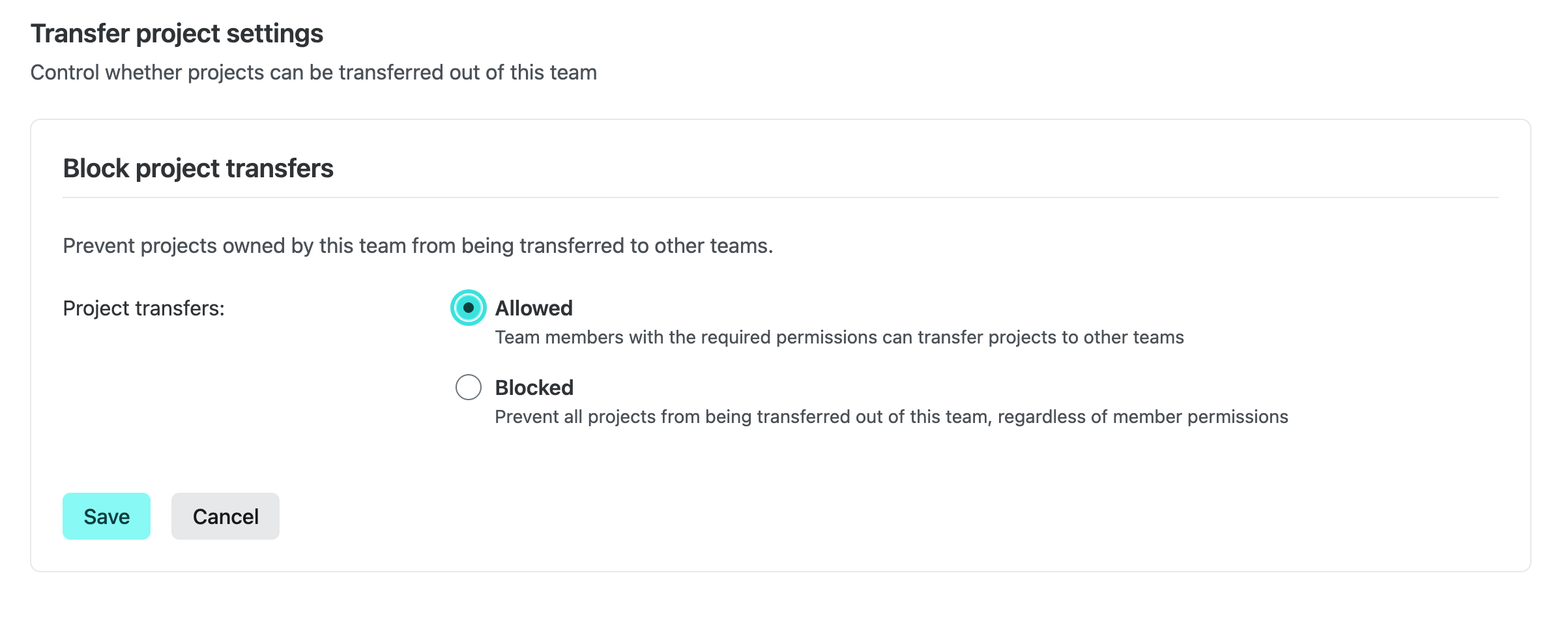
When transfers are blocked, the Transfer project action is hidden for every project owned by the team and the backend rejects transfer requests for those projects.
Enterprise defaults
Enterprise teams start with project transfers set to Blocked for security reasons, but Team Owners can change this setting to Allowed at any time. Only Team Owners can change this setting and changes are recorded in the team audit log.
Learn more
Learn more in our docs on Transferring a project.
-
The Next.js and React teams have disclosed twelve security vulnerabilities: one in React Server Components and eleven in Next.js, all patched on May 6, 2026, plus a follow-up advisory on May 7. The issues span middleware/proxy bypass, cross-site scripting (XSS), server-side request forgery (SSRF), cache poisoning, and denial of service (DoS). No detailed proof-of-concept information has been published. Here’s what Netlify customers need to know.
Summary
If you run Next.js on Netlify, we strongly recommend upgrading
nextto 15.5.18 or 16.2.6 and redeploying. This also brings in the patched React Server Components dependency. Projects using Pages Router with i18n and Next.js Middleware / Proxy also need OpenNext Netlify Next.js adapter v5.15.11. If you usereact-server-dom-*outside of Next.js, upgrade to 19.0.6 / 19.1.7 / 19.2.6 matching your React minor. See What should I do? for full steps.Netlify’s platform is not vulnerable to several of these CVEs. Image Optimization, WebSocket SSRF, RSC cache poisoning, and the cache-poisoned-redirect bypass do not affect Netlify projects. See Impact on Netlify for the per-CVE verdict.
Vulnerabilities
React (
react-server-dom-*)This affects
react-server-dom-webpack,react-server-dom-parcel, andreact-server-dom-turbopack. The Next.js advisory GHSA-8h8q-6873-q5fj tracks the same issue downstream.Vulnerability Severity Affected versions Fixed in GHSA-rv78-f8rc-xrxh — DoS in Server Components (CVE-2026-23870) High 19.0.0–19.0.5, 19.1.0–19.1.6, 19.2.0–19.2.5 19.0.6, 19.1.7, 19.2.6 Next.js
All Next.js issues are patched in 15.5.18 and 16.2.6. Earlier minors of 15.x and 16.x will not be patched; affected projects must upgrade to a patched minor.
Vulnerability Severity Affected versions GHSA-8h8q-6873-q5fj — DoS with Server Components High ≥13.0.0 GHSA-267c-6grr-h53f — Middleware / Proxy bypass in App Router via segment-prefetch routes High ≥15.2.0 GHSA-26hh-7cqf-hhc6 — Follow-up to GHSA-267c-6grr-h53f: incomplete fix for middleware.tswith TurbopackHigh ≥15.2.0 GHSA-mg66-mrh9-m8jx — DoS via connection exhaustion in apps using Cache Components High ≥15.0.0 (apps using Cache Components) GHSA-492v-c6pp-mqqv — Middleware / Proxy bypass through dynamic route parameter injection High ≥15.4.0 GHSA-c4j6-fc7j-m34r — SSRF in applications using WebSocket upgrades High ≥13.4.13 GHSA-36qx-fr4f-26g5 — Middleware / Proxy bypass in Pages Router applications using i18n High ≥12.2.0 GHSA-ffhc-5mcf-pf4q — XSS in App Router applications using CSP nonces Medium ≥13.4.0 GHSA-gx5p-jg67-6x7h — XSS in beforeInteractivescripts with untrusted inputMedium ≥13.0.0 GHSA-h64f-5h5j-jqjh — DoS in the Image Optimization API Medium ≥10.0.0 GHSA-wfc6-r584-vfw7 — Cache poisoning in React Server Component responses Medium ≥14.2.0 GHSA-vfv6-92ff-j949 — Cache poisoning via collisions in React Server Component cache-busting Low ≥13.4.6 GHSA-3g8h-86w9-wvmq — Middleware / Proxy redirects can be cache-poisoned Low ≥12.2.0 Impact on Netlify
Denial of service
GHSA-8h8q-6873-q5fj and GHSA-mg66-mrh9-m8jx are server-side denial-of-service (DoS) vulnerabilities. On Netlify, these have minimal impact: our autoscaling serverless architecture means that a malicious request resulting in a crashed or hung function does not affect other requests. However, active exploitation could increase your function costs. Note that Cache Components (GHSA-mg66-mrh9-m8jx) is an opt-in Next.js feature that is not enabled by default. Upgrading Next.js resolves both.
GHSA-h64f-5h5j-jqjh affects the Next.js Image Optimization API. Netlify projects are not affected: this Next.js code path is not used on Netlify — image optimization is handled by Netlify Image CDN, a separate service that runs outside your project’s functions with its own protections against this class of issue.
Middleware / proxy bypass
These four CVEs affect Next.js middleware and proxy routing. Because Netlify runs Next.js middleware via our own edge function adapter, the impact varies per CVE:
- GHSA-3g8h-86w9-wvmq (cache-poisoned redirects): Netlify projects are not affected. Our OpenNext Netlify Next.js adapter already varies cached responses on the
x-nextjs-dataheader. - GHSA-492v-c6pp-mqqv (dynamic route parameter injection): Netlify projects are affected, and the upstream Next.js fix applies. Upgrading Next.js resolves the issue.
- GHSA-36qx-fr4f-26g5 (Pages Router i18n bypass): Netlify projects using Pages Router with i18n and Next.js Middleware / Proxy are affected. The upstream Next.js patch alone does not resolve this on Netlify; a Netlify-specific fix shipped in OpenNext Netlify Next.js adapter v5.15.11. See how to upgrade below.
- GHSA-267c-6grr-h53f (App Router segment-prefetch bypass) and GHSA-26hh-7cqf-hhc6 (follow-up): Netlify projects are affected, and the upstream Next.js fix applies. Upgrading Next.js resolves both.
Cross-site scripting
GHSA-ffhc-5mcf-pf4q and GHSA-gx5p-jg67-6x7h are client-side XSS vulnerabilities. Regardless of hosting provider, all apps using CSP nonces in App Router or passing untrusted input to
beforeInteractivescripts may be vulnerable. Upgrade Next.js to remediate.Server-side request forgery
GHSA-c4j6-fc7j-m34r affects applications using WebSocket upgrades. Netlify projects are not affected: Netlify Functions and Edge Functions do not support WebSocket upgrades, so this Next.js code path cannot be exercised on Netlify.
Cache poisoning
GHSA-wfc6-r584-vfw7 and GHSA-vfv6-92ff-j949 affect React Server Component response caching. Netlify projects are not affected: Netlify’s CDN does not rely on the
_rsccache-busting query parameter (so collisions in it cannot poison cache entries), and it honorsVaryon RSC-related request headers.What should I do?
We strongly recommend upgrading as soon as possible to patched releases:
- Next.js projects: upgrade
nextto 15.5.18 or 16.2.6. This bundles the patched React Server Components dependency, so a separatereact-server-dom-*upgrade is not needed. - Direct
react-server-dom-*users (React Router RSC, Vite RSC plugin, custom RSC setups): upgradereact-server-dom-webpack,react-server-dom-parcel, orreact-server-dom-turbopackto 19.0.6, 19.1.7, or 19.2.6 — matching your React minor.
For Next.js 13.x and 14.x users: patches are not planned for these versions. Consider upgrading to Next.js 15.x or 16.x.
For projects using Pages Router with i18n and Next.js Middleware / Proxy (GHSA-36qx-fr4f-26g5), the upstream Next.js fix does not fully apply on Netlify. The fix ships in OpenNext Netlify Next.js adapter v5.15.11:
- Auto-installed adapter (default): redeploy.
- Manually installed adapter: upgrade
@netlify/plugin-nextjsto v5.15.11 and redeploy. We recommend not pinning the adapter version so future fixes ship automatically.
Note that any publicly available deploy previews and branch deploys may remain vulnerable until they are automatically deleted. Consider deleting these deploys manually.
Resources
- GHSA-3g8h-86w9-wvmq (cache-poisoned redirects): Netlify projects are not affected. Our OpenNext Netlify Next.js adapter already varies cached responses on the
-
A denial-of-service (DoS) vulnerability (CVE-2026-23869, CVSS 7.5) has been disclosed affecting React Server Components (RSCs), a feature used by Next.js and other React metaframeworks. A malicious payload can cause excessive CPU consumption. Here’s what Netlify customers need to know.
Impact on Netlify
Nominally, this is a server-side DoS vulnerability. However, on Netlify this has minimal impact: our autoscaling serverless architecture means that a malicious request resulting in a crashed or hung function does not affect other requests. However, active exploitation could increase your function costs.
Affected frameworks
All RSC frameworks are affected:
- Next.js (see version table below)
- React Router 7 (if using RSC preview)
- Waku
@parcel/rsc;zą@vitejs/plugin-rsc
Astro, Gatsby, and Remix are not affected.
React affected versions
See the React advisory for full details.
Affected versions Fixed in 19.0.0–19.0.4 19.0.5 19.1.0–19.1.5 19.1.6 19.2.0–19.2.4 19.2.5 Next.js affected versions
See the Next.js advisory for full details.
Affected versions Fixed in 13.3.0+ EOL - no fix 14.x EOL - no fix 15.0.0–15.5.14 15.5.15 16.0.0–16.2.2 16.2.3 What should I do?
If any of your projects are using an affected version, we recommend upgrading as soon as possible to a patched release.
For Next.js 13.x and 14.x users: patches are not planned for these versions. Consider upgrading to Next.js 15.x or 16.x.
Note that any publicly available deploy previews and branch deploys may remain vulnerable until they are automatically deleted. Consider deleting these deploys manually.
Resources
-
Netlify now automatically blocks bot scans targeting PHP paths across all plans — no configuration required.
Previously, these bots generated noise in Observability logs and metrics. They showed up without a
User-Agentheader. Netlify now blocks them at the edge.Since rolling out edge-level blocking on December 28, 2025, Netlify has blocked 2.9 billion of these requests.